


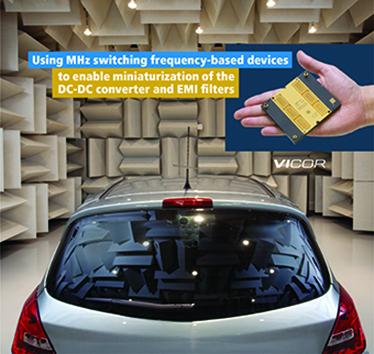
MHz switching frequency-based devices enable miniaturization of the DC-DC converter and EMI filters
Achieving EMI conducted emission compliance for automobiles with a single stage filter. By Nicola Rosano, Sr. Strategic FA/System Engineer at Vicor
More details...

A full brick package developed by TDK-Lambda, the PF1500B-360, is for high voltage distributed power architectures
More details...
The company says the series combines a compact 3.2 × 1.6 mm footprint with low DC resistance and rated current capability up to 11 A, enabling noise suppression without introducing excessive power loss. These characteristics support stable performance in space‑limited designs.
As power densities increase and PCB assemblies become more compact, designers face tighter limits on allowable insertion loss while maintaining effective high‑frequency noise suppression. Ferrite beads used in these environments must carry higher currents without thermal overstress or impedance degradation. The MH3261‑T Series addresses these constraints by pairing low DCR with a wide impedance range, supporting EMI control in dense layouts while operating across a broad temperature range from –55 °C to 125 °C.
Edward Liu, Director of Magnetic Components at Bourns says: “High-density power require ferrite beads that can carry substantial current without compromising impedance or thermal margin,” said Edward Liu, Product Line Manager, Component Magnetics, Bourns. “The MH3261‑T Series was developed to provide low DC resistance and rated current up to 11 A in a compact footprint, helping designers manage EMI in constrained layouts while maintaining operating stability over the full –55 °C to 125 °C temperature range.”
View PDF
| Privacy Policy | Site Map | © Copyright DFA Media
| Web design by Immersive Media